Best Time to Trade Forex: 2,173 Signals of Data
Not a timezone chart — 2,173 tracked signals: session win rates, average payoff per trade, and the session that quietly loses money.
Every "best time to trade forex" article gives you the same thing: a timezone chart, a paragraph about liquidity, and the confident claim that the London/New York overlap is where the money is.
Nobody shows you trades.
We can. Every signal we send is tracked from entry to exit and published weekly, winners and losers. So instead of repeating the folklore, we pulled 2,173 completed signals from our database — February 24 to July 10, 2026 — bucketed them by the session they fired in, and measured what each window actually paid in R (profit measured in units of risk: +2R means the trade made twice what it risked).
The short version: the folklore is half wrong, and the most popular session in the folklore is the one that lost us money.
The session map (so we're speaking the same language)
These are the windows our platform uses, in UTC and US Eastern (summer):
| Session | UTC | US Eastern |
|---|---|---|
| Asia | 00:00–07:00 | 8 PM–3 AM |
| London open | 07:00–09:00 | 3–5 AM |
| London morning | 09:00–13:00 | 5–9 AM |
| London/NY overlap | 13:00–16:00 | 9 AM–12 PM |
| New York | 16:00–22:00 | 12–6 PM |
| Off hours | 22:00–00:00 | 6–8 PM |
What 2,173 signals actually paid, by session
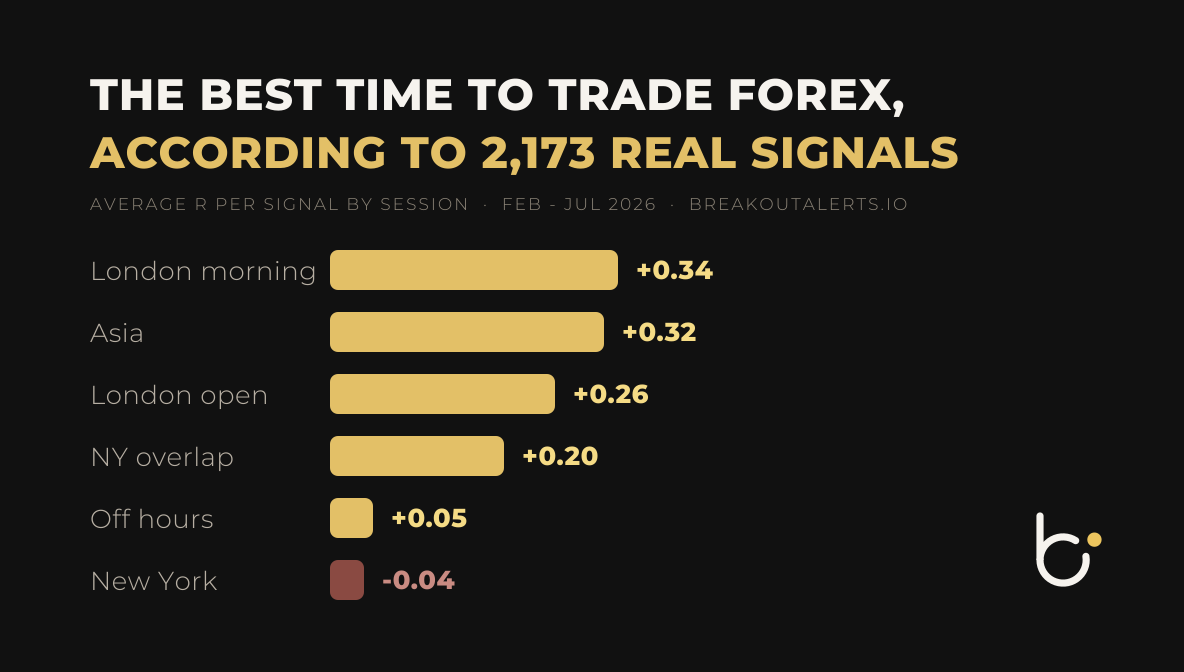
| Session | Signals | Win rate | Net R | Avg R / signal |
|---|---|---|---|---|
| London morning | 425 | 32% | +143.6R | +0.34 |
| Asia | 503 | 32% | +161.7R | +0.32 |
| London open | 226 | 32% | +59.6R | +0.26 |
| London/NY overlap | 409 | 39% | +83.3R | +0.20 |
| Off hours | 106 | 46% | +5.3R | +0.05 |
| New York | 504 | 36% | −19.9R | −0.04 |
Three things in that table contradict most of what's written about forex sessions.
First: New York — on its own, after the overlap ends — was our worst window. Not "slightly weaker." Net negative, across a sample of 504 signals. The US afternoon produced breaks that reversed more often and ran shorter when they did work. If your trading day starts after US lunch, you were fighting our entire dataset.
Second: the "dead" Asian session was our biggest earner in total. +161.7R across 503 signals. Quiet doesn't mean unprofitable — it means orderly. Ranges are cleaner, levels get respected, and the setups that form in Asian hours resolve into the expansion that follows. (This is the entire premise of the Asian range breakout.)
Third: the London/NY overlap — the folklore favorite — was fine, not special. +0.20R per signal is real money, but it ran at roughly half the per-trade edge of the London morning. Maximum liquidity turns out to be a different thing from maximum edge: the overlap has the most participants, which also means the most noise, the most stop-hunts, and the most crowded breaks.
The win-rate trap (read this twice)
Look at the table again. The highest win rate on the board — off hours at 46% — made almost nothing: +0.05R per signal. The London morning won just 32% of the time and was the most profitable window per trade.
That's not a paradox; it's how expectancy works. Slow sessions produce small, frequent wins and the occasional full-size loss. Expansion sessions produce frequent small losses and winners that run for multiples of risk. The number that compounds your account is average R, not win percentage — a lesson our own weekly results repeat constantly, including a +27R week that won only 31% of its trades.
If you're evaluating any signal service, any strategy, any backtest: ask for the R math, not the accuracy claim.
Session × strategy: where the edge concentrates
Averages hide the good parts. Splitting by strategy (minimum 10 signals per cell), the extremes:
| Session | Strategy | Signals | Win rate | Avg R |
|---|---|---|---|---|
| London open | Asian range breakout | 44 | 25% | +0.79 |
| London morning | Breakout | 280 | 27% | +0.45 |
| Off hours | Mean reversion | 43 | 63% | +0.37 |
| Asia | Breakout | 372 | 26% | +0.38 |
| New York | Breakout | 329 | 31% | −0.07 |
| Overlap | Mean reversion | 110 | 47% | −0.09 |
The single best cell in the entire dataset is the one the theory predicts: Asian range breakouts fired at the London open — a 25% win rate that still paid +0.79R per signal, because when the overnight range breaks with the London bell, it travels. That one cell contributed +34.6R from just 44 signals.
The worst pairings are just as instructive: momentum strategies in the US afternoon (breakouts in NY: −0.07R avg over 329 signals) and mean reversion during the overlap, where "reversion to the mean" collides with the day's strongest directional flows.
Same alerts. Same instruments. The clock changed the outcome.
The golden hours (and the one to avoid)
Zooming from sessions to single UTC hours, with the caveat that hourly samples are smaller:
- 10:00 UTC (6 AM ET) was the standout hour of the dataset: +97.6R total.
- 15:00 UTC (11 AM ET) — the last overlap hour — combined a 43% win rate with +62.4R.
- 04:00–06:00 UTC (12–2 AM ET) quietly stacked +125R across the late-Asian stretch.
- 19:00 UTC (3 PM ET) was the black hole: −29.1R at a 21.7% win rate. If we deleted one hour from the calendar, it's this one.
A practical playbook by schedule
If you can trade 5–9 AM ET (London morning): you're sitting in the best seat in our data. Trade the expansion; this is prime time for breakout entries on H1.
If you're at a desk 9 AM–12 PM ET (overlap): good window, crowded tape. Be pickier — demand real closes beyond levels, not wick-pokes, because this is false-breakout rush hour.
If you can only trade US afternoons: respect the data — size down, expect chop, or use the time to prepare instead: mark the levels, set the alerts, let the next session trigger them.
If you're a night owl (8 PM–3 AM ET): the Asian session rewards patience and mean reversion, and it's where the next morning's range is built. The range you mark at midnight is the trade you take at the London open.
And if you can't sit in front of charts during your best window at all — that's precisely why we built real-time alerts with the session logic baked in. The clock knowledge above is already encoded in how our signals are filtered and scored.
The honest caveats
This is one firm's tracked data, not a law of nature. Specifics worth knowing: the dataset is 2,173 completed signals across FX majors, gold, silver and oil, Feb 24 – Jul 10, 2026; it reflects our strategy mix (breakout-family and mean-reversion systems), so a scalper or news trader would see a different map; sessions are bucketed by the hour a signal fired, and exits can land later; and five months is a solid sample but still one regime — we republish these numbers as they evolve, and if the map changes, you'll read it here and in The Dossier first.
Past performance is not indicative of future results. Signals are educational market alerts, not investment advice. Trading involves risk.
Frequently asked questions
What is the best time to trade forex? In our tracked data (2,173 signals, Feb–Jul 2026), the London morning (09:00–13:00 UTC / 5–9 AM ET) and the Asian session (00:00–07:00 UTC / 8 PM–3 AM ET) produced the strongest results per trade — about +0.32 to +0.34R per signal. The popular pick, New York, was our weakest window.
Is the New York session good for forex trading? It was our worst: 504 signals netted −20R between 16:00 and 22:00 UTC despite a respectable-looking 36% win rate. US-afternoon breaks reversed more and ran less in our data.
Can you trade forex at night (US time)? Yes — the Asian session (8 PM–3 AM ET) was our second-best window overall, and it's where the range behind the classic London-open breakout gets built. Mean reversion also performed well in the quiet hours.
What are the forex session times in ET and UTC? Asia 00:00–07:00 UTC (8 PM–3 AM ET) · London open 07:00–09:00 UTC (3–5 AM ET) · London morning 09:00–13:00 UTC (5–9 AM ET) · Overlap 13:00–16:00 UTC (9 AM–12 PM ET) · New York 16:00–22:00 UTC (12–6 PM ET) · Off hours 22:00–00:00 UTC (6–8 PM ET).
Does a higher win rate mean a session is better? No. Our highest win-rate window (off hours, 46%) barely broke even, while London morning won just 32% of the time and paid the most per trade. Expectancy — average R — is what compounds, not accuracy.
The takeaway
The best time to trade forex — in tracked, published data rather than folklore — was the London morning and the Asian session, the best single setup was the Asian range breakout at the London open, and the most overrated window was the US afternoon, which quietly bled money while posting a perfectly respectable win rate.
Which is the whole lesson in one line: the market pays expectancy, not accuracy — and expectancy keeps office hours in London.
Want these numbers updated weekly, with every winner and loser on the record? The Dossier is free, every Saturday — and the breakout statistics page keeps the session-by-session table live, methodology and sample sizes included.
We got receipts.
Every signal our desk fires, graded in R — winners and losers, no cherry-picking. One email, every Friday.
Share this post
Know a trader who could use this one? Send it their way.