The Chart Patterns Cheat Sheet
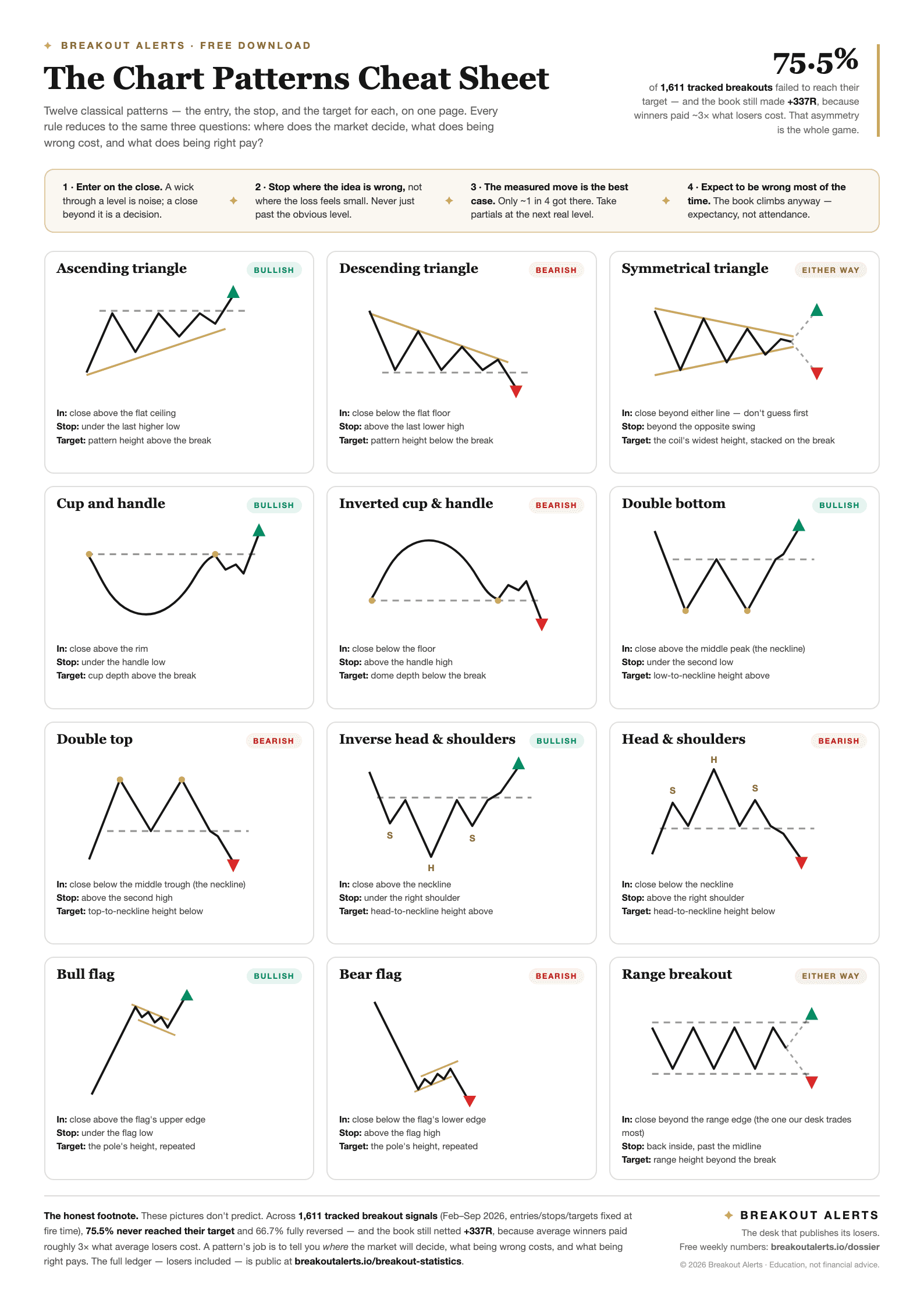
Twelve classical patterns — the entry, the stop, and the target for each, on one page. Plus the part other cheat sheets leave out: how often breakouts actually fail, measured.
What’s on the sheet
Every pattern reduced to the same three answers: where you enter, where you’re wrong, and what the classical measured move promises.
- Ascending triangleBullish
- Descending triangleBearish
- Symmetrical triangleEither way
- Cup and handleBullish
- Inverted cup and handleBearish
- Double bottomBullish
- Double topBearish
- Inverse head and shouldersBullish
- Head and shouldersBearish
- Bull flagBullish
- Bear flagBearish
- Range breakoutEither way
The linked patterns have full deep-dive guides; more are on the way — the sheet ships first because it’s the thing people actually tape to the desk.
The footnote that makes it useful
Most pattern cheat sheets sell certainty: draw the shape, collect the measured move. Ours carries a number the others won’t print — in our study of 1,611 tracked breakouts, 75.5% never reached their target. The book still netted +337R, because the average winner paid about three times what the average loser cost. That’s the actual job of every pattern on the sheet: not predicting the break, but handing you a defined place to be wrong and a reason to let winners run.
The numbers come from our public signal ledger — every alert graded, losers included, updating as the book grows. If you want the deep-dive on any single shape, start with the cup and handle or the ascending triangle, or take the free breakout trading course from zero.
Questions
Is the chart patterns cheat sheet really free?
Yes — the PDF downloads directly from this page with no email, no account, and no watermark tricks. If you want the numbers behind it as they update, the weekly Dossier below is optional and also free.
What patterns are on the cheat sheet?
Twelve: ascending, descending and symmetrical triangles; cup and handle and its inverted twin; double bottom and double top; head and shoulders and the inverse; bull and bear flags; and the plain range breakout. Each comes with a diagram, the entry trigger, the stop placement, and the classical target on one A4 page.
Do chart patterns actually work?
Not the way most explainers imply. Across 1,611 breakouts our desk tracked with entries, stops and targets fixed at fire time, 75.5% never reached their target — and the book still made +337R, because average winners paid roughly three times what average losers cost. Patterns are worth learning as maps of where the market will decide and what being wrong costs, not as predictions.
Can I print it?
It is built for printing: one A4 page (US Letter works too), light background, no ink-heavy fills. Most traders keep it next to the screen — the point of a cheat sheet is to be glanced at mid-trade, not stored in a downloads folder.
We got receipts.
Every signal our desk fires, graded in R — winners and losers, no cherry-picking. One email, every Friday.
Share this cheat sheet
Know a trader who could use this one? Send it their way.
The sheet spots the shape. We watch the levels.
Breakout Alerts tracks every level behind these patterns across 24 instruments and fires rule-based alerts the moment one breaks — entry, stop and target defined at send, every result published. Free for 14 days.